Tag: Social Work

  • Nelson Mandela Day 2022

    Nelson Mandela Day 2022

    “Do what you can, with what you have, where you are”

    Yearly on 18 July 2022, South Africa celebrates Nelson Mandela Day! 

    At Dube & Pottas Inc we strongly believe in uplifting the dignity of others.

    https://www.mandeladay.com/ states that “In 2009, when the United Nations General Assembly declared Nelson Mandela’s 18 July birthday Nelson Mandela International Day, Madiba called on the people of the world to honour him by helping their communities.”

    Every year the Foundation focuses on a different theme. In 2022 they highlight the plight of food security and climate change with the tagline, “Do what you can, with what you have, where you are.”

    https://www.mandeladay.com/pages/what-can-i-do shares ideas on what you can do to Celebrate Mandela Day this year. Here are a few of the suggestions:

    • Plant and grow fresh, organic and cost-effective produce in or for vulnerable communities.
    • Throw a tea party for the children and carers at a children’s home.
    • Offer to mow the lawn and fix up the garden at a nursing home or hospice.
    • Become an organ donor.
    • Volunteer at an animal shelter.
    • Donate magazines and books to an under-resourced home for the elderly.

    Like and follow our Social Media Pages to see what we are doing on Nelson Mandela Day!

    To donate R30 to the work of Nelson Mandela Day, SMS #ACTIONAGAINSTPOVERTY to 42607

    “When a man has done what he considers to be his duty to his people and his country, he can rest in peace. I believe I have made that effort and that is, therefore, why I will sleep for the eternity.”

     – Nelson Mandela

    3D rendering of the flag of South Africa on satin texture.
  • A Social Workers Role in the Stroke Recovery Process

    A Social Workers Role in the Stroke Recovery Process

    World Stroke Day is on the 29th of October and in honour of the World Stroke Organisation’s pledge to raise awareness around this topic, we want to use this opportunity to raise awareness about a social workers role in the stroke recovery process.

    The Importance of Social Work During the Recovery Process.

    A stroke may only last for a few hours, however, the long-lasting symptoms, physical and psychological effects can last a lifetime for some. Therefore, it’s our job as social workers to provide an array of services to assist the patient and their loved ones through this difficult time in their lives.

    This type of work is rather complex because we need to be able to find the delicate balance between the medical truths, nursing practices, therapeutic methods and social interventions involved when rehabilitating a stroke patient back to health and a place confidence within themselves. 

    “A social worker is a great asset for a patient and the support system of the patient due to the unique nature a social worker examines the challenges a patient experiences.” ~ Alexander Carlson, St. Catherine University. Let’s take a look at the three different phases of a stroke and where our work as social workers comes into play.

    Social Work During Acute Care of Stroke Patients

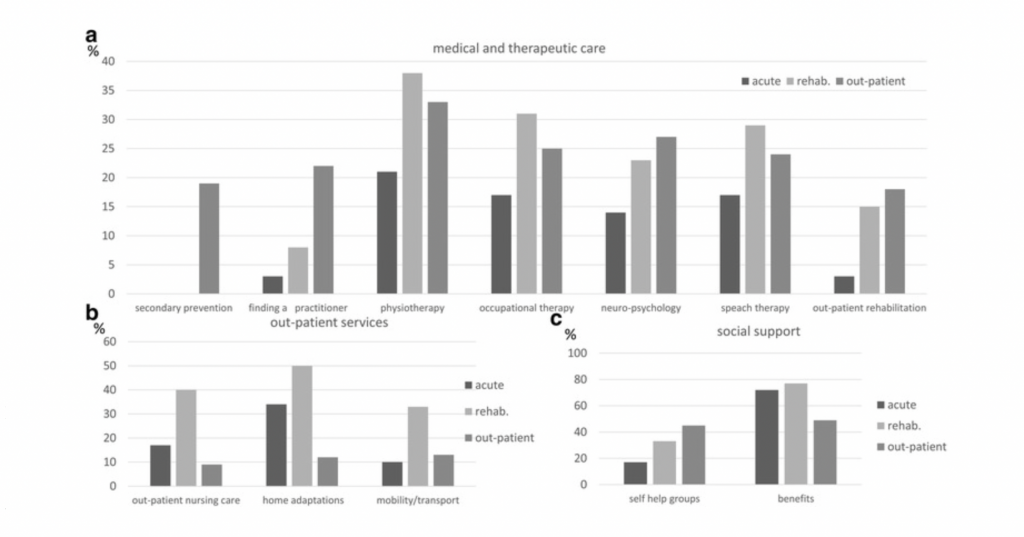
    Most of our work here is focused on medical and therapeutic care. As the patient is still in the hospital and can feel rather overwhelmed. The most common services we provide at this stage are speech therapy, occupational therapy, physical therapy and neuropsychology. Additionally, we assist with the admin side of things. For example: finding practitioners, informing family members and finding nursing care options that are personalized to suit each individual experience. We also organize the specifics of their discharge transportation or mobility, home adaptations and social support such as benefits and self-help groups.

    Social Work During the Rehabilitation Phase of Stroke Patients

    This work is very similar to that of the acute stage however, we focus more on post-discharge adjustment. We assist in facilitating the continuation of the patients’ treatments like physiotherapy, speech therapy, neuropsychology and occupational therapy. While also introducing more out-patient services. For example: assisting in home adaptations, mobility and organizing at-home nursing care. This is to ensure that the patients’ transition from hospital to at-home rehabilitation causes the least amount of stress to the patient.

    Social Work During the Out-patient Phase of Stroke Patients

    At this point in the recovery process, we have to focus on patient adjustment. Social workers will have to provide both education and counselling for the patient and their families to assist them in processing the realities of the event and its aftermath. Here is where we offer counselling for the patient as well as family meetings. We also focus on social support such as finding social self-help groups within the community.

    Therefore, as you can see from the figure below, our services as social workers are required at all stages of patient stroke recovery. However, it’s important to note that every case is different. It’s up to us as the social worker to provide whatever service is necessary to ensure that the patient feels confident in their return to health. 

    Fig 2. Social work after stroke: identifying demand for support by recording stroke patients’ and carers’ needs in different phases after stroke.
    Inken Padberg, Petra Knispel, Susanne Zöllner, Meike Sieveking, Alice Schneider, Jens Steinbrink,Peter U. Heuschmann, Ian Wellwood, and  Andreas Meisel
    Copyright © The Author(s). 2016

    This year, on World Stroke Day, help us raise awareness about the hard-working social workers who quietly work behind the scenes to ensure that all patients and their loved ones can navigate their way through this highly stressful time. We hope to educate more people about our importance in the rehabilitation and recovery process of stroke patients. So feel free to share this post on social media to help us spread the word. And please remember:

    “Alone we can do so little; together we can do so much.”

    ~ Helen Keller
  • Covid-19 Netcare Family Connect Project

    Covid-19 Netcare Family Connect Project

    In January 2021, we collaborated with the Netcare group as they launched the Covid-19 Netcare Family Connect Project. It focused on keeping Covid-19 patients and their loved ones connected. This project was launched during the second wave of the Covid-19 Pandemic.

    How did we help?

    Our Social Workers worked around the clock to assist in rendering our services to many patients in need. We worked hard to ensure that we were able to assist families and patients in staying connected and feeling safe during this stressful time.

    Our services rendered

    • We assisted in providing telephonic feedback to family members regarding their loved one’s medical condition.
    • Provided emotional and supportive counselling to families, staff members and most importantly the affected patients.
    • Provided bereavement and grief counselling to family members who lost their loved ones due to Covid-19.
    • Arranged family member visitations and supported members during these visitations.
    • Facilitated video calls with patients and their family members in order to stay connected.
    • Employer Liaison to ensure the necessary arrangements and documentation was in order.
    • Provided Financial and Social Assistance.
    • Referral to community resources.
    • Discharge planning for affected patients in order to ensure a stress-free transition.
    • Arranged follow-ups post-discharge.
    • Debriefing and support groups were conducted with staff members in order to assist them during this difficult time.
    DUBE Social Workers Covid Netcare Project

    Where did this project take place?

    We appointed 61 social workers across 33 Netcare hospitals to render Social Work services to patients as well as their families. Additionally, we provided assistance to the hard-working staff members situated at these hospitals.

    North East Region

    Akasia, Femina, Ferncrest, Jacaranda, Kroon, Linmed, Lakeview, Montana, Moot, N17, Pelonomi, Pholoso, Pretoria East, Sunward Park, Unitas, and Universitas Hospitals

    South West Region

    Clinton, Garden City, Krugersdorp, Linksfield, Milpark, Mulbarton, Olivedale, Park Lane, Pinehaven, Rosebank, Sunninghill, Union, Vaalpark, and Waterfall Hospitals.

    Coastal Region

    Christiaan Barnard, Kuilsrivier and UCT Hospitals

    Our reflections on the Covid-19 Netcare Family Connect Project

    Overall we believe this project was an enormous success as it had a positive impact on the lives of many patients, family members and staff members. Our patients and their families were very appreciative of the services provided as the hospitalization process was a very stressful and anxiety-provoking experience during the second wave of the Covid-19 Pandemic. Additionally, staff members also had to deal with many fears during the pandemic and the fact that they had supportive services available to them in their immediate working environment made a huge difference to their emotional wellbeing.

    Moreover, we would like to express our sincere gratitude to Netcare for the opportunity to render our services at your Hospitals. We are eternally grateful for the impact our practice made on the lives of patients, families and staff members during the Covid-19 Pandemic.

    Please feel free to share this story and give us a follow on Facebook in order to stay up to date with our work & projects.