Tag: World Stroke Day

  • The emotional impact of a stroke

    The emotional impact of a stroke

    28 October – 3 November 2022 is National Stroke Week.

    https://www.world-stroke.org/world-stroke-day-campaign/world-stroke-day states that The global awareness day was established by WSO and provides a global platform for the stroke community to increase awareness and drive action on stroke around the world.

    Dube & Pottas Inc Social Workers render Social Work Services to CVA / Stroke patients on a daily basis in Acute, Sub-Acute and Rehabilitation Hospitals. Stroke Patients are referred to Social Workers to help address emotional, family and social issues. Social Work Services are also rendered in order to ensure a safe discharge.

    Many people who survive a stroke develop feelings of fear, anxiety, frustration, anger, low mood, and a sense of grief from their physical and mental disabilities.

    Clinical depression, which is a sense of hopelessness that disrupts an individual’s ability to function, is an emotional disorder most commonly experienced by stroke survivors. It is recommended that anyone experiencing five or more of the following symptoms for more than two weeks should help:

    • Persistent sad or “empty” mood
    • Feelings of guilt, worthlessness, helplessness
    • Loss of interest or pleasure in ordinary activities
    • Decreased energy, fatigue, being “slowed down”
    • Sudden difficulty in sleeping well
    • Unexplained loss of appetite and weight, or weight gain
    • Difficult concentrating, remembering, making decisions
    • Irritability
    • Excessive crying
    • Chronic aches and pains that don’t respond to treatment
    • Thoughts of death or suicide, suicide planning or attempts

    Here are a few TIPS to fight / avoid the emotional impact of a Stroke:

    • Make the most of your rehab: the more you recover, the better you will feel the more motivated you will be.
    • Get involved in daily activities with friends or family. Many stroke survivors feel isolated and alone, even if they aren’t physically incapacitated from the stroke.
    • Set goals and measure accomplishments.
    • Plan daily activities to provide structure and sense of purpose.
    • Join a stroke support group. Other survivors will understand your issues, and offer support and ideas to help you manage your emotions. https://www.strokesurvivors.org.za/ 
    • Speak openly and honestly to your caregivers or family members about your emotional changes. Together you can work out a solution.
    • Maintain your quality of life by staying active and doing things you enjoy
    • Ask your doctor how to relieve any physical discomforts like pain, muscle spasms, and constipation

    Family support is also very important in dealing with anxiety and depression in stroke survivors. Therefore this also has an emotional impact on the family members. In many cases a family member has to fulfill the role of a Caregiver. Social Work Services rendered by Dube & Pottas Inc also focuses and addresses the emotional impact on the Family Members / Caregiver. 

    For Social Work Services  C O N T A C T  U S – info@dubepottas.co.za

    Follow us on Instagram and like us on Facebook!

  • A Social Workers Role in the Stroke Recovery Process

    A Social Workers Role in the Stroke Recovery Process

    World Stroke Day is on the 29th of October and in honour of the World Stroke Organisation’s pledge to raise awareness around this topic, we want to use this opportunity to raise awareness about a social workers role in the stroke recovery process.

    The Importance of Social Work During the Recovery Process.

    A stroke may only last for a few hours, however, the long-lasting symptoms, physical and psychological effects can last a lifetime for some. Therefore, it’s our job as social workers to provide an array of services to assist the patient and their loved ones through this difficult time in their lives.

    This type of work is rather complex because we need to be able to find the delicate balance between the medical truths, nursing practices, therapeutic methods and social interventions involved when rehabilitating a stroke patient back to health and a place confidence within themselves. 

    “A social worker is a great asset for a patient and the support system of the patient due to the unique nature a social worker examines the challenges a patient experiences.” ~ Alexander Carlson, St. Catherine University. Let’s take a look at the three different phases of a stroke and where our work as social workers comes into play.

    Social Work During Acute Care of Stroke Patients

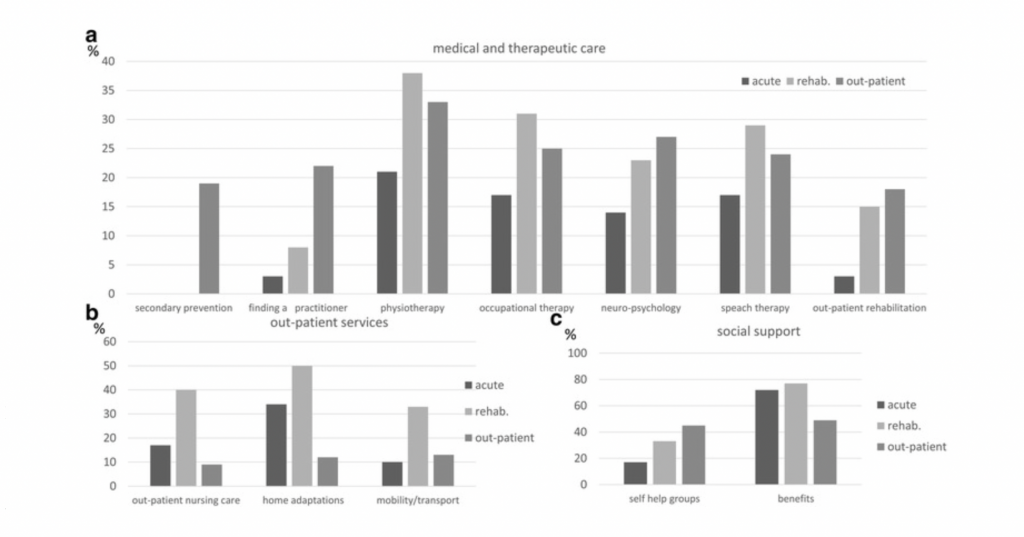
    Most of our work here is focused on medical and therapeutic care. As the patient is still in the hospital and can feel rather overwhelmed. The most common services we provide at this stage are speech therapy, occupational therapy, physical therapy and neuropsychology. Additionally, we assist with the admin side of things. For example: finding practitioners, informing family members and finding nursing care options that are personalized to suit each individual experience. We also organize the specifics of their discharge transportation or mobility, home adaptations and social support such as benefits and self-help groups.

    Social Work During the Rehabilitation Phase of Stroke Patients

    This work is very similar to that of the acute stage however, we focus more on post-discharge adjustment. We assist in facilitating the continuation of the patients’ treatments like physiotherapy, speech therapy, neuropsychology and occupational therapy. While also introducing more out-patient services. For example: assisting in home adaptations, mobility and organizing at-home nursing care. This is to ensure that the patients’ transition from hospital to at-home rehabilitation causes the least amount of stress to the patient.

    Social Work During the Out-patient Phase of Stroke Patients

    At this point in the recovery process, we have to focus on patient adjustment. Social workers will have to provide both education and counselling for the patient and their families to assist them in processing the realities of the event and its aftermath. Here is where we offer counselling for the patient as well as family meetings. We also focus on social support such as finding social self-help groups within the community.

    Therefore, as you can see from the figure below, our services as social workers are required at all stages of patient stroke recovery. However, it’s important to note that every case is different. It’s up to us as the social worker to provide whatever service is necessary to ensure that the patient feels confident in their return to health. 

    Fig 2. Social work after stroke: identifying demand for support by recording stroke patients’ and carers’ needs in different phases after stroke.
    Inken Padberg, Petra Knispel, Susanne Zöllner, Meike Sieveking, Alice Schneider, Jens Steinbrink,Peter U. Heuschmann, Ian Wellwood, and  Andreas Meisel
    Copyright © The Author(s). 2016

    This year, on World Stroke Day, help us raise awareness about the hard-working social workers who quietly work behind the scenes to ensure that all patients and their loved ones can navigate their way through this highly stressful time. We hope to educate more people about our importance in the rehabilitation and recovery process of stroke patients. So feel free to share this post on social media to help us spread the word. And please remember:

    “Alone we can do so little; together we can do so much.”

    ~ Helen Keller